


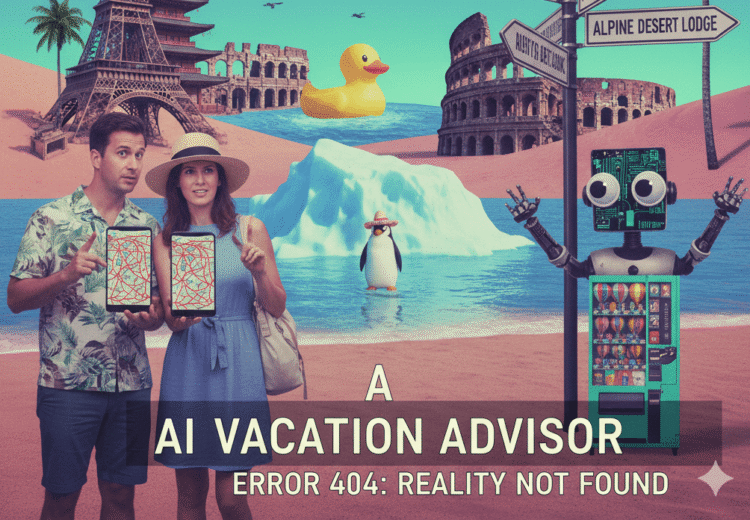
How AI Can get it very, very wrong!
Oliver BroadAI is the hot topic right now. Love it or hate it, it is here to stay—much like the internet revolution in the late 1990s. What concerns us is how quickly the world is adopting it. Some people are taking AI to the extreme, relying on it for almost everything.
There is also a worrying trend of people accepting AI-generated information as fact without verification, as we have discovered firsthand. Does RB really own a hotel in Verona? Is Gran Canaria really in the Schengen Zone? Read on to find out the answers and see how AI can get it very, very wrong…
Let me set the scene: it’s 26°C on the beautiful island of Gran Canaria in the Canary Islands, the penultimate day of our winter-sun escape. It’s time to check in online and consider our departure time from the hotel as we drive back to the airport.

“I wonder if there is any information online about immigration times to leave Gran Canaria,” I ask myself. So I open Google and type a simple question: “What is the current average waiting time for departure immigration from Gran Canaria to the UK?”
The answer was, well, worrying!
You would think that with the whole world-wide-web at its fingertips, Google’s Gemini AI tool could give a fairly accurate answer. I wasn’t expecting precise waiting times from today—maybe not even yesterday—but I thought there would be forums or social media posts suggesting whether I should arrive three hours early, or if two hours would be enough.
From personal and professional experience, I knew deep down that two hours would suffice. As there were only the two of us traveling, we are usually pretty good at skipping quickly through security and finding our gate. But I wanted to put AI to the test, as so many people are using it for exactly this reason.
The answer it gave was as follows:
“As you are flying to the UK, there will be no passport check and immigration to pass through because Gran Canaria and the UK are both in the Schengen Zone.”
Did I miss something? Did the UK not only rejoin the EU but also become part of the Schengen Zone? Had that all happened while I was sipping on a cocktail in the Canaries? Perhaps I should have checked the news more often—but I needed a digital detox, hence the holiday!
No. None of that had happened. AI had simply given me completely inaccurate information. How crazy is that?
My second example happened just this week. We received an email from a travel agency in the USA, asking us to book a room for their clients at a hotel in Verona. It was written to us as if we were the hotel reservation desk. This isn’t uncommon, but lately it has started happening twice a week!
Straight away, I thought this must be AI giving this poor travel agent the wrong information.
We do have that particular hotel featured on our website. After some research on Chat GPT, it seems the AI concluded—wait for it—“RB Collection is the management and owner of said hotel.”
Did Nathan strike a business deal I wasn’t aware of? Are we branching out into hospitality? What will my role be—Bell Boy? Reception Clerk? Concierge? I think I may be more suited to marketing, but apparently, there are things happening I don’t know about, so I’ll take anything!

The truth is, RB doesn’t own or manage a hotel in Verona. But for some reason, Chat GPT thought we did! Simply by having the hotel on our website, it provided the poor travel agent in the USA with our email and “connected the dots”—which weren’t really dots, more like a squiggle and a splodge… impossible to connect at all.
These are just two examples where AI can, and has, got things completely wrong. So please, be careful. If you must use it for research, verify the results, do your own research, and remember: there is no intelligence as good as human intelligence. ‘Artificial’ is in there for a reason—it simply isn’t real.
For a more reliable, authentic, and accurate holiday booking experience, contact one of our humans on 01543 258631.
Contact us


